SMS Opt-In Process
Last updated November 12, 2026
This page documents how end users consent to receive SMS text messages sent by AutoHound, LLC (DBA King's Auto Group) through AutoHound (autohound.io), the shop's repair-management software. Consent is collected at the shop's counter, on a private per-customer check-in link, or, where the shop publishes one, on its public booking page. The first two are not public pages a reviewer can visit, so the consumer-facing disclosure, the recording flow, and screenshots of every consent screen are reproduced here for carrier and campaign-review verification; the booking page, when published, is public and is linked below so it can be opened directly. The shop also texts the parts and sublet vendors it works with; that business-to-business consent path is documented in its own section below.
The disclosure customers are shown
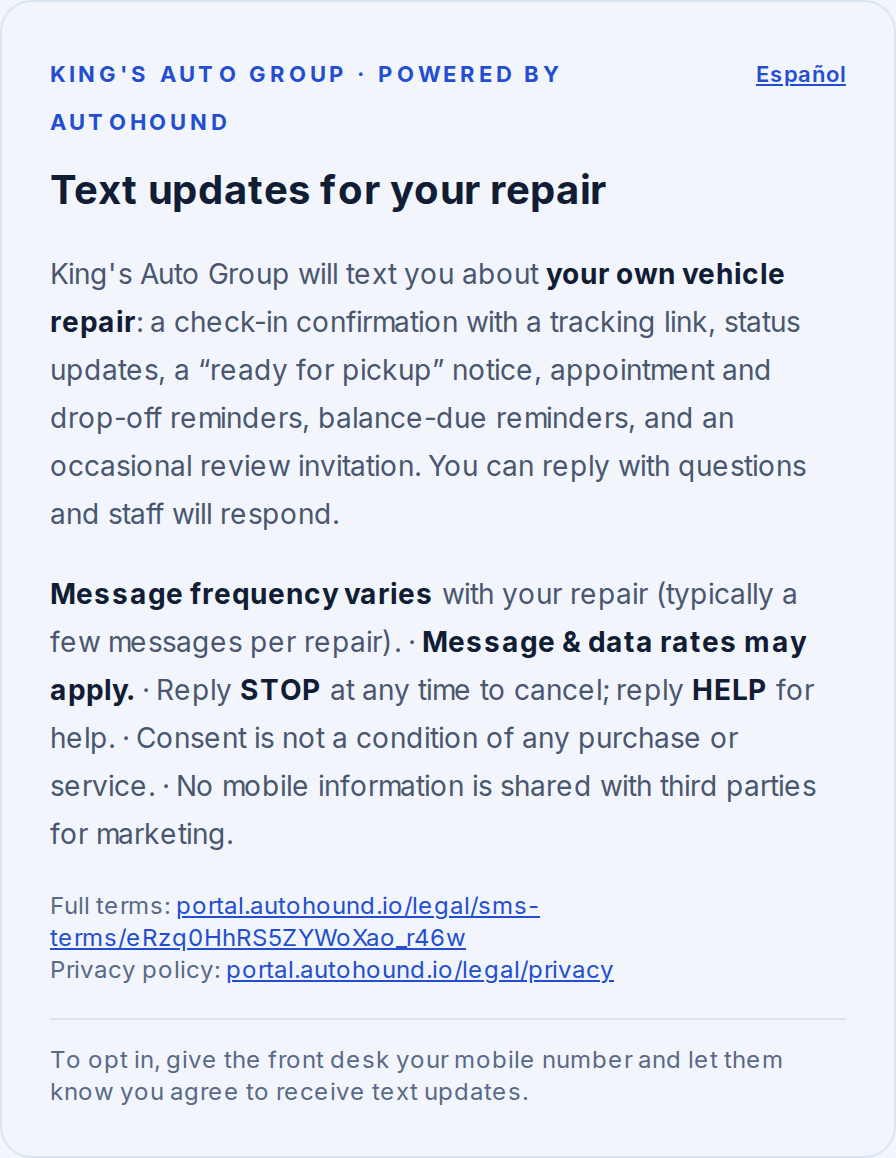
Before opting in, every customer is shown this disclosure in full (the whole of it, in these words) on every surface described below. The same card is printed for the counter and published at /legal/sms-consent-card/eRzq0HhRS5ZYWoXao_r46w. What follows is not a transcription of it: this page renders the disclosure with the same component the product renders it with, so it is the exact Call-to-Action language the consumer sees:
King's Auto Group will text you about your own vehicle repair: a check-in confirmation with a tracking link, status updates, a “ready for pickup” notice, appointment and drop-off reminders, balance-due reminders, and an occasional review invitation. You can reply with questions and staff will respond.
- Message frequency varies with your repair (typically a few messages per repair).
- Message & data rates may apply.
- Reply STOP at any time to cancel; reply HELP for help.
- Consent is not a condition of any purchase or service.
- No mobile information is shared with third parties for marketing.
How consent is collected: one disclosure, three places to give it
There is one disclosure (the one reproduced above) and the customer sees all of it before consenting. It is presented on three surfaces: at the shop's counter, on the customer's own private check-in link, and, where the shop publishes one, on its public booking page (shown further below). Consent is never collected by keyword, short code, or any text-to-join mechanism. On every surface it is optional, unchecked by default, and not a condition of any purchase or service:
- At the counter, recorded by staff. At vehicle drop-off, staff hand the customer the printed card below, which carries the disclosure in full, and ask whether they would like text updates, reading the script quoted under this list. Staff then record the customer's answer on the customer record. The card is the consent surface; the customer record is the shop's note of what they said.
- On the customer's own check-in link. Before drop-off, the shop sends the customer a private link to their own check-in. There the customer ticks an optional SMS-consent box themselves. It sits in a section of its own, headed Text updates and marked optional, outside the block of repair authorizations the check-in requires; the same disclosure sits directly above it, and the check-in submits with or without it. Pictured below, under the heading of the same name.
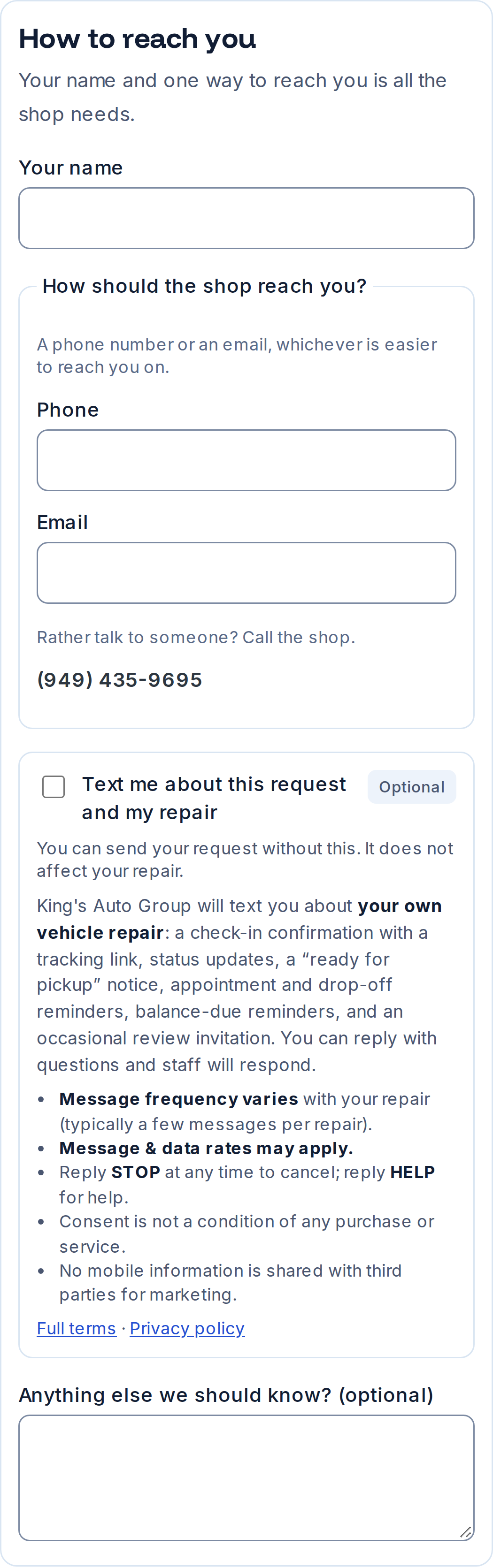
- On the shop's public booking page. Where a booking page is published, the customer ticks an optional consent box themselves, unchecked by default, with the same disclosure directly below it. Pictured at the end of this page.
The script staff read aloud, shown beside the consent control they record it with:
“We’d like to text you updates about your repair — message frequency varies, message and data rates may apply, reply STOP anytime to cancel or HELP for help. It’s optional and not required for service. OK?”
If the customer agrees, staff record it using the consent checkbox on the customer record inside AutoHound. That record is the shop's own paper trail of an answer the customer already gave to the printed card: it is not a consent surface, the customer never sees it, and it is deliberately not published here as opt-in proof. The checkbox is optional and unchecked by default. The customer record saves, and every repair service proceeds identically, whether or not it is checked. Consent is not a condition of service, account creation, or any purchase; customers who decline simply receive no text messages.
The screenshots below show the AutoHound screens themselves. Every other screenshot below was captured on King's Auto Group's own account, so the business name and terms link inside each of those images are this shop's. The customer check-in screenshot is a shared reference capture in every case: it is the one screen here that belongs to a customer's own repair order rather than to the shop, and King's Auto Group is not asked to publish a customer's check-in to prove a disclosure.
On the customer's own check-in link
The second surface is the private check-in link King's Auto Group sends to the customer before drop-off. The link is unique to that customer and their repair order and is not advertised, listed, or reachable without it. It is a private link, not a public sign-up page, and nobody can opt in through it but the customer it was sent to. The consent box sits in its own section, marked optional and kept outside the block of repair authorizations the customer must accept to check in. It is unchecked by default, the full disclosure sits directly above it (the same disclosure printed on the counter card), and the check-in submits either way:

The public booking page
The third surface is the public booking page, which King's Auto Group may publish or take down at any time. Whenever it is up, the form carries an optional SMS-consent checkbox, unchecked by default, directly above the same disclosure reproduced at the top of this page: the identical shared component, never a subset. It sits with the phone and email boxes, under the heading How to reach you, which is the fourth of the form's five short steps (and the same section of the form when it is shown on one page). Ticking it requires the customer's own phone number; the form submits identically with or without it, and consent is not a condition of requesting a drop-off day or of any service. Each web opt-in records the date, time, and the phone number the customer entered. The page is currently live, and reviewers can open it directly: portal.autohound.io/book/jBIhrY9prWrld3fmlgD1LA.
These are the only ways customer consent is obtained. There is no keyword, short code, or other text-to-join path: a customer who texts the shop's number without an opt-in already on file opens a two-way conversation thread for staff to answer, and that inbound message does not grant consent or enable any automated messaging.
What is recorded
Each opt-in stores the date and time consent was given and how it was given (the staff member who recorded it at the counter, the customer's own signed check-in on the private link, or the phone number the customer entered on the booking form) with an entry in the shop's audit trail. This record is retained per customer and applies specifically to repair-related messaging from that customer's shop.
Vendors the shop texts
Separately from customers, King's Auto Group texts the parts and sublet vendors it buys from (businesses, not consumers) to coordinate work on specific repairs: order and ETA questions, schedule confirmations, and two-way replies. No vendor message is automated or promotional; every one is composed by shop staff. Nothing sends to a vendor until staff record that vendor's consent, given by phone or in writing, and each record stores the date, time, and how it was given, with an entry in the shop's audit trail. A vendor replying STOP is blocked immediately, exactly as a customer would be, and vendor messages observe the same nighttime quiet hours.
Enforcement
No automated or campaign message is ever sent without a recorded opt-in: every status update, reminder, ready-for-pickup notice and review invitation is gated on consent, and staff cannot compose a message to a customer on file until consent is recorded. The one exception is a reply the customer asked for: an inbound text from a number with no opt-in on file opens a two-way conversation thread staff may answer in. The customer started that exchange; it does not record consent and does not enable any automated messaging. Replying STOP immediately blocks further messages; START re-subscribes a customer who had previously opted in and then stopped, and has no effect for anyone else; HELP returns assistance information. Sends are also restricted during nighttime quiet hours.
Related policies
See the SMS Terms & Conditions and Privacy Policy. No mobile information is shared with third parties or affiliates for marketing or promotional purposes.